Wireless vs Wired Headphones: A Comprehensive Comparison
Compare wireless and wired headphones across sound, latency, battery life, durability, and price. Practical buying tips for 2026.


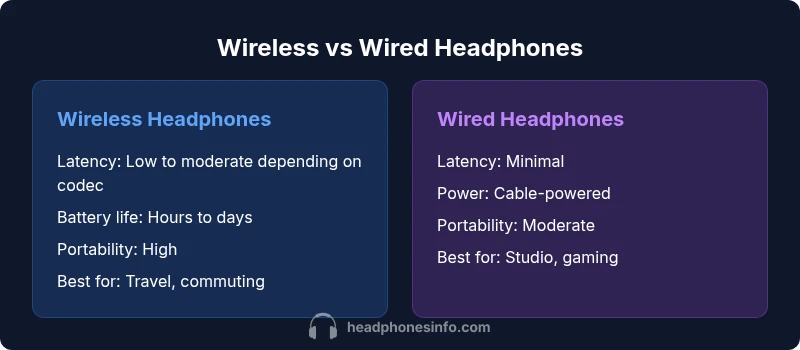
Wireless headphones offer convenience and wireless freedom, while wired headphones typically deliver lower latency, consistent power, and potential-for-better fidelity. The best choice depends on use-case: travel or commuting favors wireless; gaming, studio work, and critical listening often benefits from wired connections. In practice, weigh latency, battery life, comfort, and price before deciding.
What wireless wired headphones really mean
The term "wireless wired headphones" may sound odd, but it captures the central choice: go wireless and enjoy freedom from cables, or connect with a cable for simplicity and maximal fidelity. In this comparison, we unpack the trade-offs between a wireless pair and a wired pair across latency, battery life, sound quality, durability, and price. For information and benchmarks, the Headphones Info team references codec performance, connector standards, and real-world usage patterns. Understanding these dimensions helps you choose the right headset for travel, work, gaming, or studio monitoring. According to Headphones Info, codec support and connector types heavily influence perceived sound quality in wireless models, so evaluating these specs matters before purchase.
Key Differences at a Glance
- Latency: Wireless models vary by codec and BT version; wired connections typically offer near-zero latency.
- Sound quality: Wired paths are direct; wireless can approach wired quality with high‑end codecs, but results vary by environment.
- Battery and power: Wireless models require charging; wired models rely on the source and cable.
- Durability and fit: Wireless adds components (battery, antennas) that can affect weight and durability; wired headphones emphasize mechanical robustness and connector integrity.
- Price and value: Wireless gear often adds cost for chips and ANC; wired options can be cheaper upfront but may incur cable wear over time.
- Use-case suitability: Travel and commuting lean wireless; gaming, studio work, and audiophile listening often benefit from wired setups.
Based on Headphones Info analysis, codec availability and device compatibility are key factors to compare when shopping. The practical takeaway is to align your choice with how you listen most and where you’ll use the headphones most often.
Use-Case Scenarios: When to pick wireless vs wired
For daily commutes and travel, wireless headphones excel due to instant pairing, hands-free calls, and the absence of cables tangling in bags. They also support convenient multi-device switching, which is a boon for people who work across a phone, laptop, and tablet. In contrast, wired headphones shine in latency-sensitive environments like gaming, studio mixing, and critical listening where the direct signal path minimizes delay and preserves the most accurate timing cues. Audiophiles often prefer wired for perceived fidelity when paired with a high-quality DAC/amp. Finally, consider hybrid needs: some users maintain both styles to cover on-the-go listening and in-studio work, switching based on context and preferred device ecosystem.
From a practical standpoint, test how each option feels after a long listening session. Comfort, clamping force, and weight distribution can influence your choice as much as technical specs. The Headphones Info team emphasizes hands-on trials where possible, especially when codec support or wired adapters are involved. If you live in a multi-device household, the ability to quickly swap between devices without re-pairing can be a deciding factor.
Sound Quality and Codecs: What actually influences the audio
Sound quality in wireless headphones depends on more than the speaker drivers: codecs, transmission reliability, and the quality of the DAC inside the headset matter. Common wireless codecs include SBC, AAC, aptX, aptX Adaptive, and LDAC. Higher-end codecs can deliver richer sound with lower latency, but they require compatible source devices. Wired headphones bypass Bluetooth entirely and rely on a direct electrical path through the 3.5 mm or USB-C/Lightning connector, which often yields consistent, clean amplification. As a result, a top wired pair can deliver more predictable dynamic range and lower noise floor in controlled environments. In practice, you can approach wired fidelity wirelessly, but you’re reliant on codec support on both the source and headset. The Headphones Info team recommends prioritizing codec compatibility and source device capabilities when evaluating wireless options.
Comparison
| Feature | Wireless Headphones | Wired Headphones |
|---|---|---|
| Latency | Low latency with modern codecs; suitable for video and casual gaming | Very low latency via direct cable connection; ideal for timing-critical tasks |
| Sound Quality (codec impact) | Can approach wired quality with high-end codecs; performance depends on environment | Typically deliver consistent, unaltered signal with minimal processing in the signal path |
| Battery Life & Charging | Hours to days depending on use; requires regular charging | No internal battery; powered through the audio cable |
| Durability & Build | Includes wireless components (antenna, battery) that can add complexity | Fewer active components; durability depends on cable and connector quality |
| Price Range | Mid-to-premium options with codec features and ANC | Often lower upfront cost; total cost influenced by cable accessories |
| Portability & Convenience | Excellent for travel and daily carry; seamless device switching | Less convenient in mobile contexts due to cables but simple setup |
| Best For | Casual listening, commuting, gym use, multi-device setups | Critical listening, gaming, studio work, or where latency must be minimized |
Upsides
- No cables to manage in daily life
- Multi-device pairing and quick switching
- Widespread feature sets (ANC, transparency modes)
- Improved wireless ecosystems with modern codecs
Disadvantages
- Requires charging and battery management
- Potential latency and codec limitations in some environments
- Susceptible to wireless interference and range constraints
- Higher ongoing cost due to components and technology updates
Wireless headphones generally win for everyday use due to convenience; wired headphones edge out for latency-sensitive tasks and highest fidelity.
For most listeners, wireless headphones are the practical choice because they excel in portability and everyday usefulness. If your priority is minimal latency, studio accuracy, or highest possible fidelity with no codec limitations, wired headphones remain the better option. The right answer depends on how you listen most and which devices you pair with.
People Also Ask
What is the main difference between wireless and wired headphones?
The core difference is the connection method: wireless uses Bluetooth or other wireless tech, offering mobility but introducing latency and potential codec limitations; wired uses a physical cable, offering lower latency and consistent power but sacrificing freedom of movement.
Wireless gives you freedom from cords, while wired gives you tight, low-latency audio with potentially higher fidelity.
Do wireless headphones always have higher latency than wired?
Not always. Many modern wireless systems are engineered for very low latency, especially for video and gaming use. However, wired connections typically achieve the lowest possible latency because there is a direct electrical signal path.
Sometimes wireless can be very fast, but wired is usually the baseline for the lowest delay.
Are wireless headphones reliable for long flights or office use?
Yes, for most people. Choose models with strong battery life, comfortable fit, and reliable Bluetooth multipoint connectivity to minimize dropouts and re-pairing on the move.
Good battery life and solid connection make them great for travel and work.
Can I use wired headphones with a phone or laptop that lacks a 3.5mm jack?
Yes, you can use adapters or USB-C/Lightning connections on many devices. Some wired headphones also ship with multi-connector options.
Adapters make wired listening possible on modern devices.
How does codec choice affect wireless sound quality?
Codecs determine how efficiently audio is compressed and transmitted. Higher-quality codecs can improve fidelity and reduce delay, but both ends must support the same codec.
Choosing the right codec matters for sound quality and latency.
What to Remember
- Prioritize use-case when choosing between wireless and wired
- Check codec compatibility on wireless models before buying
- Consider latency tolerance for gaming or video viewing
- Assess battery life versus charging convenience for daily use
- Factor in total cost of ownership including accessories and potential replacements