What Happens When Your Headphones Stop Working
Urgent, step-by-step troubleshooting guide on what happens when your headphones stop working and how to fix common issues fast. Learn tests, diagnostics, and prevention from Headphones Info.


What happens when your headphones stop working
If you search for the exact phrase what happens when your headphones stop working, you’re likely trying to understand both the problem and the fix. In most cases, you’re experiencing a predictable sequence of symptoms that point to a few common culprits. When a pair of headphones suddenly stops delivering sound, or only outputs from one side, it’s rarely a mysterious hardware defect. More often, it’s a battery drain, a loose connection, a misbehaving app, or a compatibility glitch. The Headphones Info approach is to treat every symptom as a clue, then test simple hypotheses in a safe, repeatable order. With calm, methodical steps, you can confirm whether the issue is user-caused or device-related and choose an appropriate remedy. This section will lay out the typical pathways from symptom to solution, so you can act quickly and confidently. Bear in mind that the same logic applies across wireless over-ears, true wireless buds, and traditional wired headphones. A structured approach reduces downtime and protects against accidental damage from careless resets or forceful tinkering.
Whether you’re using wireless over-ears, true wireless buds, or wired cans, the same diagnostic logic applies. Start by ruling out obvious causes like a dead battery or a loose USB-C/Lightning/3.5mm connection, then move to pairing, firmware, or hardware faults. A disciplined approach minimizes guesswork and keeps your devices safe from unnecessary resets.
Common causes at a glance
Many headphone problems boil down to a handful of root causes. The most frequent are battery or charging failures, Bluetooth pairing or codec mismatches, and cable or adapter problems. Other common culprits include outdated firmware or drivers, dirty or damaged jacks, and environmental factors like moisture or static. Finally, physical wear—frayed wires, loose connections, or blown drivers—can silently degrade performance. Understanding these causes helps you prioritize checks and avoid unnecessary replacements. In practice, you’ll often find that fixing one simple item (charging, reseating a connector, or re-pairing) clears multiple symptoms. Headphones Info suggests starting with the easiest checks, then moving to device-level settings and firmware considerations. When you know which category your issue belongs to, you can select the most effective fix without guesswork.
Quick checks you can perform
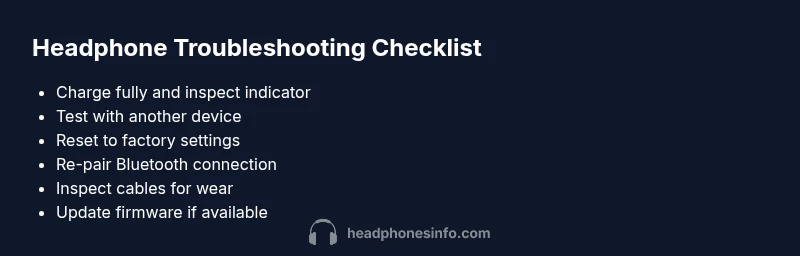
Before diving into deeper troubleshooting, run a handful of quick checks that cover the majority of problems. First, charge fully and observe any LEDs or on-device indicators. Next, test with a different source or device to rule out the original device as the culprit. Check the volume, mute, and balance settings to ensure sound isn’t being silenced or directed to another channel. If you have wired headphones, test the cable and jack with a known-good device. Do a soft reset or power cycle, then re-pair if using Bluetooth. If available, install any firmware updates to improve compatibility and fix known issues. Finally, try a different cable, dongle, or adapter to eliminate a faulty intermediary. If none of these steps resolve the issue, move to the next phase of diagnosis. Safety note: never force connections or apply excessive force to ports; unplug carefully.
Diagnostic flow you can follow
This section outlines a practical flow to map symptoms to causes and fixes. Start by identifying the symptom: no sound, intermittent sound, or audio only in one side. Then map the symptom to likely causes: battery/charging, pairing/codec, or cable/adapter. For no sound across all sources, focus on battery, resets, and firmware. For sounds that crackle intermittently, consider driver damage or loose connections. For mono audio, inspect the driver assembly and cable integrity. After selecting a probable cause, apply the corresponding fix and re-test. If sound returns inconsistently or after a reset but then dies again, re-check the context: updated apps, recent cable changes, or a new Bluetooth environment may be the trouble. If the problem persists across multiple sources and after a factory reset, it’s likely hardware failure requiring professional service.
Step-by-step fixes for the most common issue
The most common issues tie back to battery, pairing, or cable problems. Follow these steps in order and stop after each fix when the symptom clears. Step 1: Fully charge the headphones and inspect the charging indicator. If the LED stays off or shows an abnormal color, try a different charger or cable and inspect the port for debris. Step 2: Perform a factory reset or device reset as described in the user manual. Step 3: Re-pair the headphones with your phone or computer, forgetting the device first and then establishing a fresh connection. Step 4: Update firmware or drivers if an update is available in the companion app. Step 5: Inspect cables and adapters for wear, and swap in a known-good cable if possible. Step 6: If you still have no sound, test with another source to confirm whether the issue is the headphones or the amplifier in the source device. Pro tip: keep a small pack of spare cables and a charger handy to streamline future fixes.
Prevention and maintenance to avoid future failures
Long-term reliability comes from smart charging habits, protective storage, and periodic sanity checks. Charge your headphones before they drop to near-zero, avoid leaving them in hot cars, and store them in a protective case to prevent physical wear. Periodically clean the ports with a dry, soft brush and check cables for fraying or kinks. Keep firmware up to date and test pairing with a second device every few weeks to catch compatibility issues early. When you notice changes in sound quality, test with multiple sources to determine whether the issue is device-specific. Finally, if you rely on critical listening, consider investing in a reputable warranty or service plan to address hardware faults quickly.