Wireless Headphones vs Wired: An Objective Side-by-Side
A data-driven comparison of wireless headphones vs wired, examining latency, sound quality, battery life, durability, and use-case scenarios to help you choose.


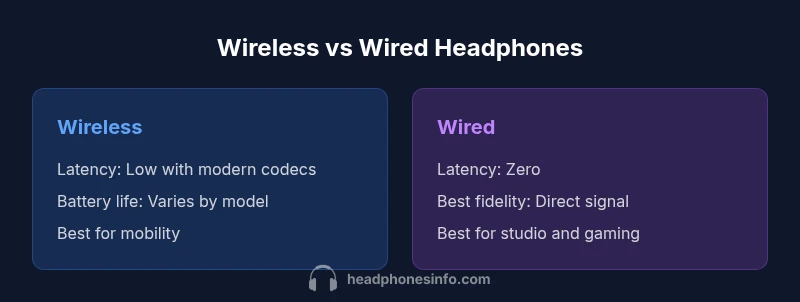
Wireless headphones vs wired: Wireless options maximize freedom of movement and device pairing, at the cost of latency, battery management, and occasional interference. Wired headphones deliver zero-latency, stable sound with no battery constraints, but tether you to a source. For everyday listening, wireless often wins; for critical listening or studio work, wired typically remains more reliable.
The Core Trade-offs: Latency, Battery, and Reliability
In evaluating wireless headphones vs wired, the central trade-offs are latency, power management, and signal stability. According to Headphones Info, wireless systems depend on radio or Bluetooth codecs to move audio from source to driver, which introduces buffering and possible dropouts. Modern low-latency codecs and improved antennas have narrowed the gap, making wireless suitable for many daily tasks. However, the final audio latency and jitter can still vary by device, codec, and source. By comparison, wired connections provide a direct electrical signal with near-zero latency and consistent impedance, avoiding wireless interference and battery concerns. This reliability matters most for critical listening, professional editing, and real-time gaming where timing matters. When you weigh wireless advantages—portability, multi-device pairing, and fewer cables—against wired strengths—robust fidelity, zero delay, and no battery anxiety—you’ll need to match your use case to the equipment. Headphones Info's data-driven approach emphasizes testing both forms with your typical workflow. In practice, most listeners opt for wireless for everyday listening and casual work, while wired remains the default for studio tasks and high-fidelity sessions.
Comparison
| Feature | Wireless headphones | Wired headphones |
|---|---|---|
| Latency | Low with modern codecs | Zero latency |
| Sound Quality | High fidelity depends on codec and DAC | Generally very high fidelity; direct path reduces variance |
| Battery / Power | Battery-powered; needs charging | No battery; powered by source |
| Durability & Build | Wireless components add complexity | Fewer moving parts can be robust |
| Comfort & Fit | Battery adds weight on some models | Usually lighter without battery modules |
| Price / Value | Often premium upfront for features | Lower upfront cost, no cables to wear |
| Best Use Case | Mobility, travel, multi-device use | Studio work, gaming, stationary listening |
Upsides
- Freedom of movement with cable-free design
- Convenient multi-device pairing and switching
- No physical wear from cables for wireless models
- Compact travel-ready setups with portable cases
Disadvantages
- Requires charging and battery management
- Potential latency and interference in crowded environments
- Codec quality and compression can impact fidelity
- Long-term ownership costs for premium wireless kits
Wired headphones excel in latency-free accuracy; wireless headphones win on mobility and convenience
If you prioritize timing and studio accuracy, wired is the safer default. For everyday listening and travel, wireless provides unmatched convenience, especially with modern low-latency codecs.
People Also Ask
What is the main difference between wireless and wired headphones?
The main difference is latency and signal integrity: wireless relies on codecs and radio transmission, which can introduce delay and compression; wired provides a direct signal path with near-zero latency and consistent fidelity.
The main difference is latency and signal integrity: wireless uses codecs and radio transmission, which can add delay and compression; wired provides a direct path with minimal latency.
Do wireless headphones degrade audio quality?
Not inherently. Modern wireless codecs can deliver near-wired quality under ideal conditions, though codec choice and interference can affect dynamics and treble handling.
Not inherently. Modern codecs can sound very close to wired, but codec choice and interference can affect dynamics.
Are wireless headphones good for gaming?
Wireless gaming headsets can be excellent for convenience, but some players still prefer wired for zero-latency timing. Look for low-latency modes and wired dongles.
Wireless can be convenient for gaming, but wired often offers zero-latency timing. Look for low-latency modes.
Which lasts longer, wireless or wired?
Wired headphones do not require charging and can last as long as your source device, while wireless models depend on battery health and charging habits.
Wired often lasts longer in continuous use since there’s no battery to drain.
Is Bluetooth the same as wireless?
Bluetooth is a common wireless protocol, but there are other wireless options (RF, USB-Dongle) used by gaming headsets and studio headphones.
Bluetooth is a common wireless method, but other wireless options exist such as RF or USB dongles.
What should I consider when choosing?
Consider use case, codec support, latency, comfort, battery life, and budget. Testing is essential to see which setup matches your needs.
Think about use case, codecs, latency, comfort, and budget; test before you buy.
What to Remember
- Test latency for gaming/work: wired often wins
- Evaluate codecs when wireless to maximize quality
- Balance battery life with mobility in wireless plans
- Keep a wired backup for critical listening